#200: Building Positioning Bets
Today is a very special day for me (and a BIG milestone).
You're currently reading the 200th edition of the PMM Camp newsletter. On November 30, 2022 I first hit send, and now 1,446 days later, here we are.
Some quick math shows that I’ve written about 175,000 words which is the equivalent of three books! In that first edition, I said my mission was to “help product marketers build high impact careers.” And that hasn’t really changed.
Before we get into today's topic, I just want to say thank you.
Each and every one of you has helped shape this newsletter into what it is today. I am eternally grateful for your ideas, feedback, and support. But most of all, for welcoming me into your inbox every Sunday.
I do have one simple ask. If you’ve ever gotten value from this newsletter (a framework, resource, words of reassurance) I’d love your help. Would you share it with a PMM who should be subscribed too?
Now onto the topic of the day: positioning.
Like every product marketer, I'm a Fletch superfan. So when I heard Anthony Pierri and Rob Kaminski were running a one-week cohort on how to actually apply their positioning framework, I knew I had to be there.
After 12 hours of class, I had one big takeaway: positioning is about making bets. In today's edition, I'm going to share what I learnt about how to design the right positioning bets and then decide on which one to take.
Let's get into it.
Building Positioning Bets
As PMMs, we often think about positioning as a writing exercise. We spend hours going back and forth on the exact words until everyone is happy with them. But the biggest thing I took away from Fletch’s cohort is that positioning has no single right answer.
There are many different ways you could position your product, and each one of them is a potential bet you can make. When you think of it this way, it becomes a much more interesting conversation than whether you’re using the "right" word or not. The question becomes: which bet is worth making?
You’re essentially deciding where to commit your company’s limited time, money, and people for the next 12 to 18 months, if not longer.
Rob and Anthony define positioning as choosing a space where you’re going to live in the customer’s mind, and then showing how you’re different from the reference point you’ve chosen. To get there, you need to make five decisions across five core elements: category, segment, competition, limitation, and differentiation.
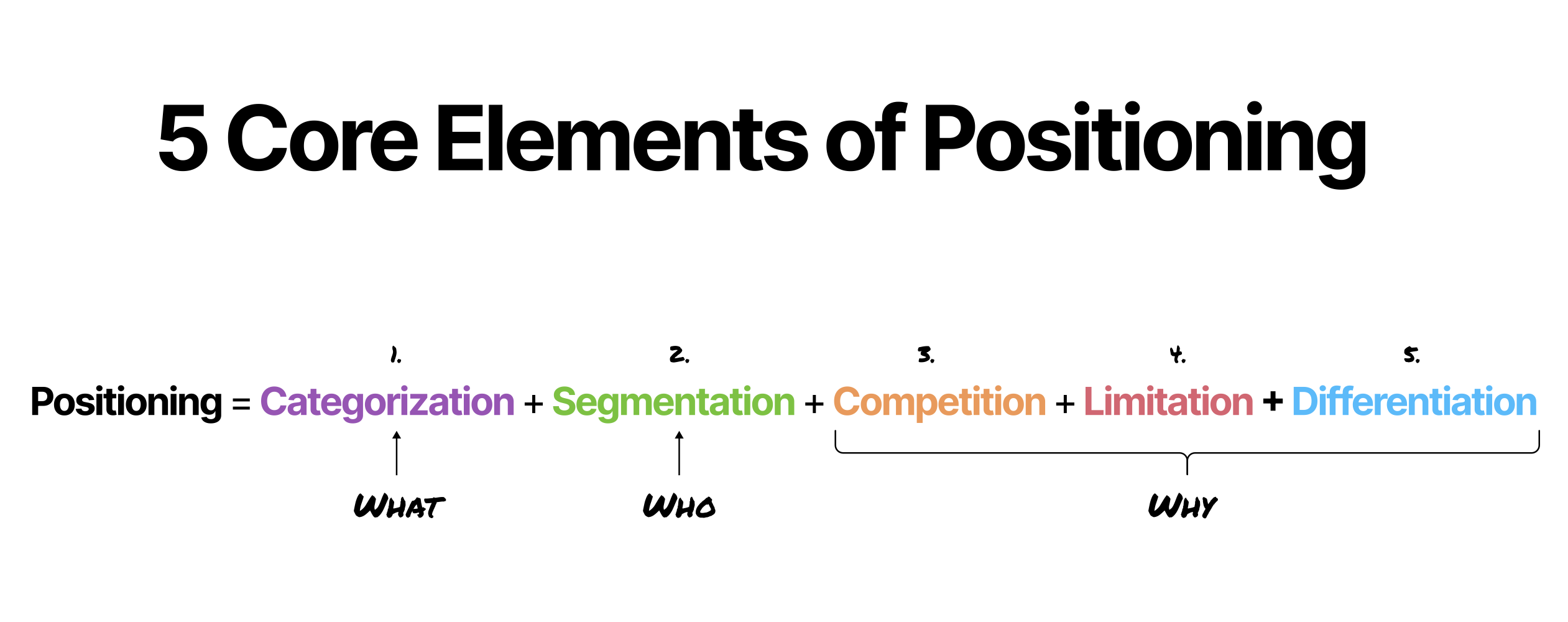
Category
Do you want to position in an existing category, or around a job to be done?
When you choose a category, you’re putting yourself on a shelf with the other vendors, and that dictates who you have to differentiate from. The power of an existing category is that it already has built-in demand. People are budgeting for it and shopping for it, so you don’t have to convince them they need the tool.
When you position around a job, you anchor on what your customer is trying to get done. Rob and Anthony call these activity-based markets. Your competition becomes the way people do that job today.
Segment
Who are you positioning for?
Most ICP docs include firmographics like industry, company size, and job title. But two companies with similar firmographics may still react to your positioning in completely different ways.
That’s because they each have a different relationship to your category. You need to assess how aware of your category they are, and whether they’re already participating in it.
This fundamentally changes the ask. Are you asking people to rip and replace something they already have, or adopt something net new?
Competition
What do you want to be compared to?
If your buyers are aware of your category and participating in it, they’ll compare you to other vendors. If they aren’t, they’ll compare you to however they’re getting the job done today, even if that’s a spreadsheet or manual work.
Rob and Anthony see this as a choice you get to make. You’re inviting the comparison, so pick the one that puts your differentiation in the best possible light.
Limitation
What’s wrong with the thing you’re being compared to?
Once you know your comparison, you need to show what’s bad about it. Against other vendors, you need to show what’s wrong with the other tools in your category. Against the status quo, you need to convince people that their current way of working isn’t good enough.
Anthony pointed out that these arguments aren’t interchangeable. If your buyer already pays for a tool in your category, you might point out how expensive it is. But to someone who doesn’t pay for anything today, that same argument makes you the expensive option.
Differentiation
Why are you better than the thing you’re being compared to?
This is where you show how you overcome the limitation above. Once you’ve pointed out what’s wrong with the thing you’re being compared to, your differentiation is how you fix it.
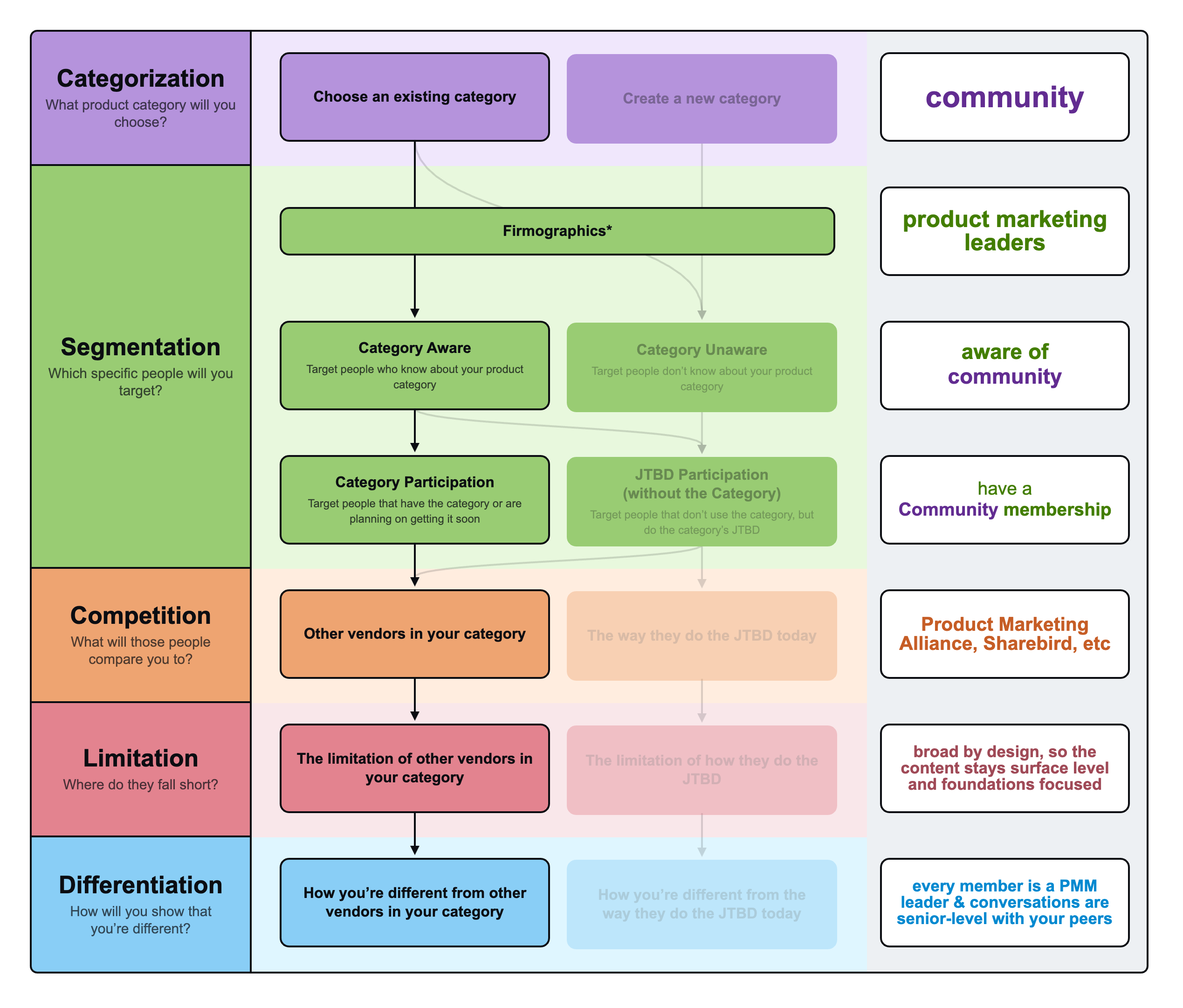
Now that you have all of the ingredients, you can pull them together into a bet. Then repeat the process as many times as you like, until you’ve mapped out every potential bet you might consider.
Here’s an example of how my positioning bet for the PMM Camp Community came together.
Assessing Your Bets
Once you have a few bets, you need to decide which one to take! Rob and Anthony run each one through four tests.
Market fit. Do you meet the basic expectations of the market? If you’re missing too many of the features people expect, you won’t even be considered.
Differentiation. Is your argument compelling and believable? If it isn’t, you’ll need to niche down or move to another bet.
Market. Is there room for you? Look for gaps you could fill.
Execution. Can you actually do this? Do you have the resources and skills to reach these buyers, and can your product deliver on the promise?
Pick the bet you have the most conviction in and commit to it.
CAMPER ESSENTIALS
Learn the Fletch process for yourself. Built for marketers, Anthony and Rob's positioning cohort walks you through building and evaluating your own positioning bets. Join the next cohort.
Follow Anthony Pierri and Rob Kaminski on LinkedIn. They both create a ton of incredible content and share real examples of positioning tradeoffs at well-known companies.