#197: How AI Fluent Are You, Really?
Breaking it down into 4 competencies you can actually measure
I’m going to say three short phrases everyone in tech is using right now. I want you to ask yourself, on a scale of 1 to 10, how well defined you think each of these phrases is? And how aligned is everyone on what they actually mean?
AI-native
AI-fluent
AI-pilled
I’m willing to bet that if I asked you all to reply with your own definitions, I’d get hundreds of different answers.
And yet, it feels like we are all racing to become these ill-defined identities. Which kind of makes it feel like there’s no end in sight.
How will you know if you’ve become AI-native? If you have the right level of AI fluency?
The reality is, you probably won’t. You, your coworkers, and your peers are all working toward different definitions and different end states. That makes it really hard to measure your progress, let alone have a constructive conversation about it with your team or your leaders.
This idea came up during PMM Camp’s recent AI Challenge. Over three weeks, Camper Emily Dimytosh led us through how to define AI fluency for our teams and scale AI adoption responsibly.
What I learnt was that once you break AI fluency down into specific competencies, it’s so much easier to set clear expectations and have real conversations about it. And I want to help you do that too.
In today’s edition, we’ll walk through two of the most popular AI fluency frameworks from Zapier and Anthropic and explore how you can define AI fluency for your own team.
Let’s get into it.
What Does AI Fluency Really Mean?
When you think about someone at work who’s great at AI, you probably picture someone who is a builder. They’ve built custom agents, AI workflows, dashboards, and more. Maybe you’d even call them a vibe coder.
But, as Emily pointed out in our session, building is only one part of AI fluency. It’s actually the tip of the iceberg.
There’s much more to AI fluency than what you build. It’s equally important to consider how you approach building, how you assess what you’ve built, and where and when you use AI.
That’s why fluency frameworks are so helpful. They break the nebulous term “AI fluent” down into specific competencies, so you and your team can get on the same page about what good actually looks like.
Emily introduced us to two of the most popular frameworks, which come from Zapier and Anthropic. Let’s look at both to see how they compare.
Zapier’s AI Fluency Rubric
In 2025, Zapier announced that every new hire would need to meet a minimum bar for AI fluency. They publicly published the AI fluency rubric they use to assess every employee and applicant.
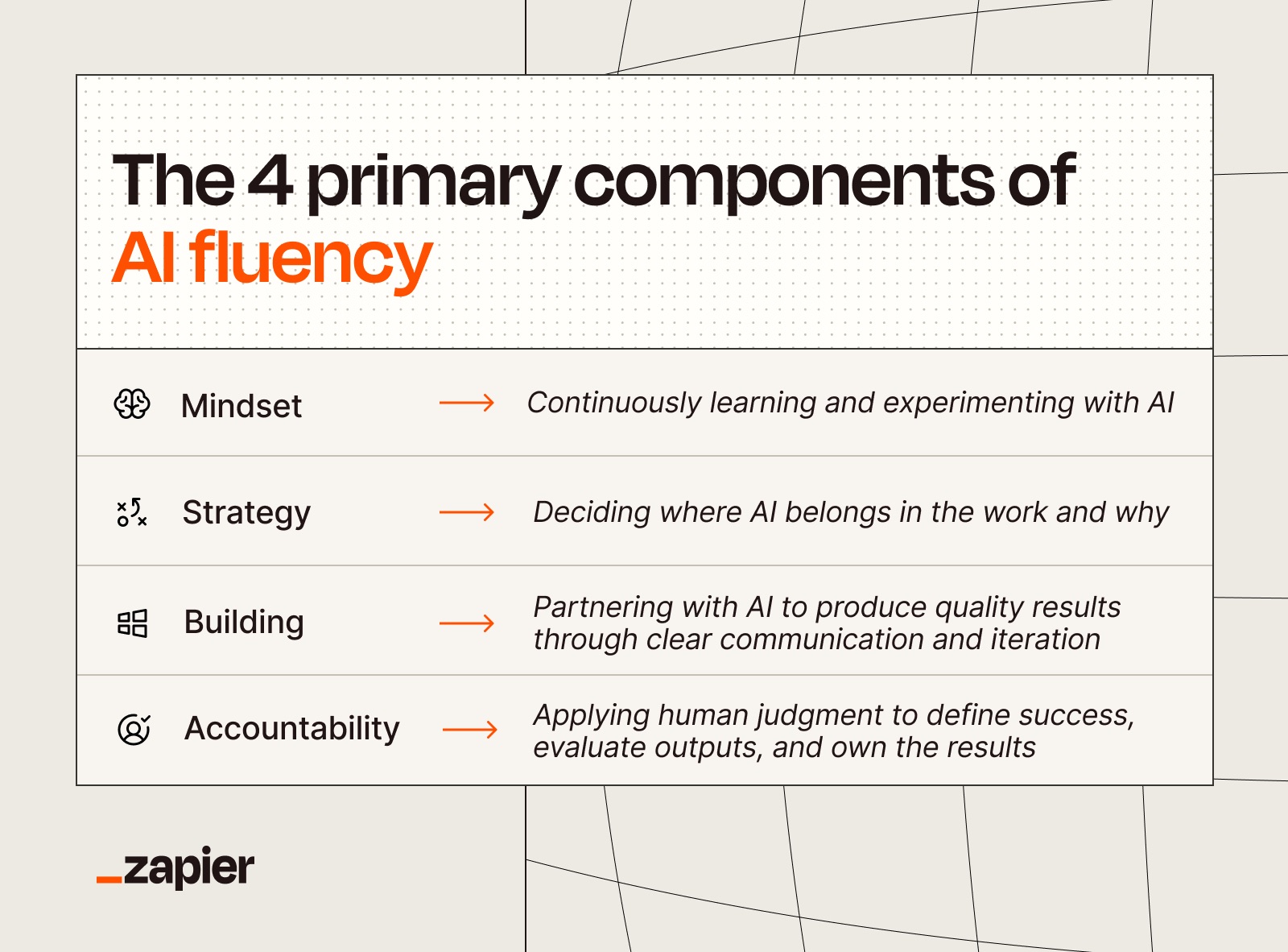
The first version looked at three competencies: Mindset, Strategy, and Building. A year later, in March 2026, Zapier released an updated version where they added a fourth competency: Accountability.
Here’s how they define each of the competencies in the rubric:
Mindset: How you approach AI. You’re continuously experimenting and learning, and the way you use AI keeps evolving.
Strategy: Deciding where AI belongs in your work and why. You use it intentionally, in the places where it makes the work better.
Building: Creating repeatable workflows and systems with AI, and refining them over time. At the higher end, these are systems your whole team relies on.
Accountability: Owning what AI produces. You set the standard before you start, review what AI gives you with a critical eye, and take responsibility for the outcome.
Each competency is scored across three levels: Capable, Adoptive, and Transformative. This lets you track how you’re improving in your fluency over time.
Anthropic’s 4D Framework
In 2025, Anthropic partnered with professors Rick Dakan and Joseph Feller to create their own AI fluency framework. It’s become the foundation of their free AI fluency course.
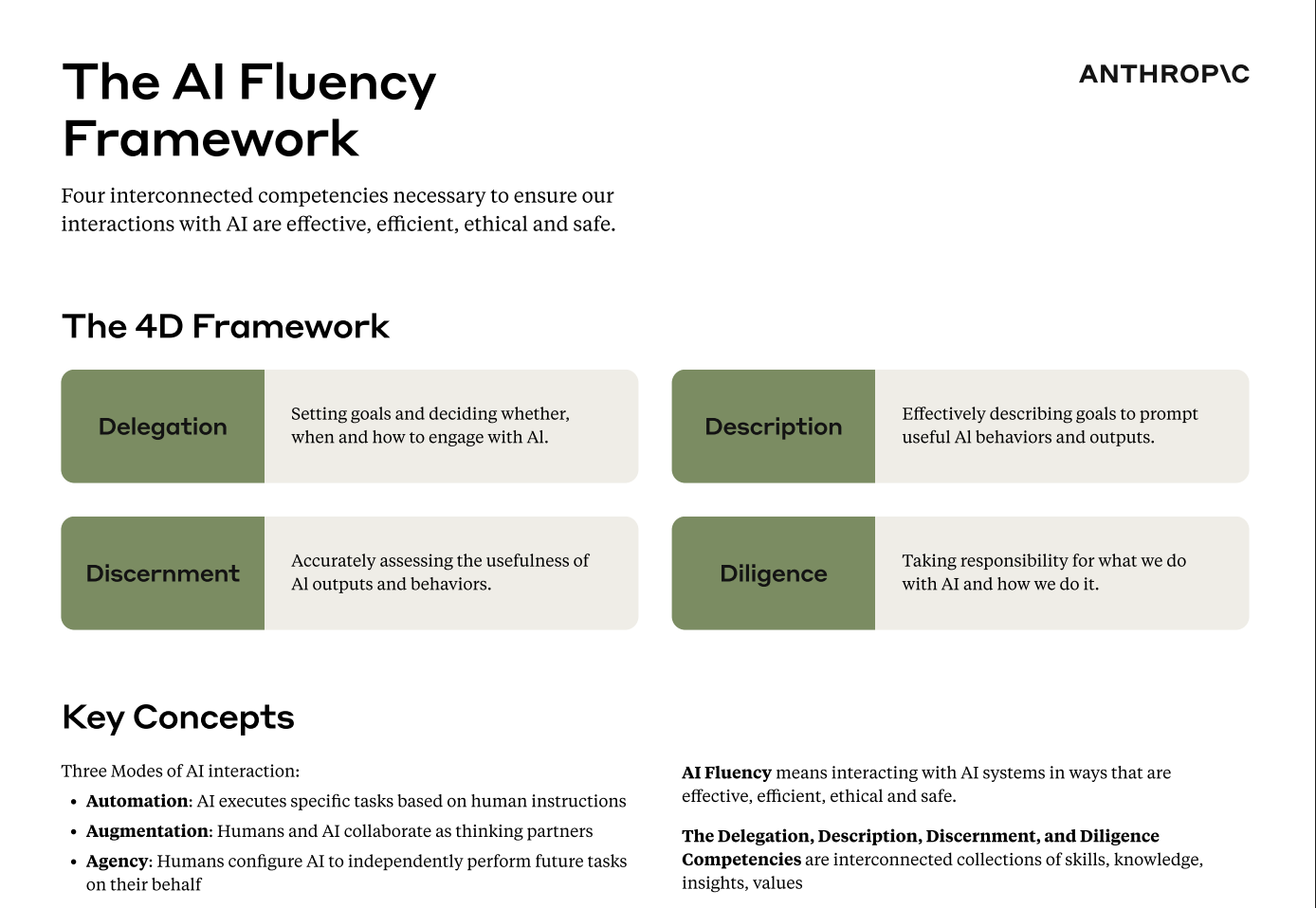
The framework is also built around four competencies, known as the 4Ds. Here’s how Anthropic defines each one:
Delegation: Deciding on what work should be done by humans, what work should be done by AI, and how to distribute tasks between them. Includes understanding your goals, AI capabilities, and making strategic choices about collaboration.
Description: Effectively communicating with AI systems. Includes clearly defining outputs, guiding AI processes, and specifying desired AI behaviors and interactions.
Discernment: Thoughtfully and critically evaluating AI outputs, processes, behaviors and interactions. Includes assessing quality, accuracy, appropriateness, and determining areas for improvement.
Diligence: Using AI responsibly and ethically. Includes making thoughtful choices about AI systems and interactions, maintaining transparency, and taking accountability for Al-assisted work.
Instead of levels (like Zapier), the 4Ds break down into 24 specific behaviors. These include things like clarifying your goal before asking for help, giving examples of what good looks like, and pushing back on AI when its reasoning doesn’t hold up. So instead of scoring which level you’re at, you can check whether you’re completing each behavior.
Even though the names are different, the two frameworks overlap a lot. Zapier’s Mindset and Strategy line up with Delegation. Building lines up with Description. And Accountability lines up with both Discernment and Diligence.
Defining AI Fluency for Your Team
In our first session of the AI Challenge, Emily asked the group whether their company had an AI fluency framework. Not a single hand went up. This just doesn’t exist at most companies.
If that’s you, and you’re starting from scratch, here’s how Emily recommends you proceed:
Pick a framework. You can start with either Zapier’s or Anthropic’s, whichever feels like the best fit. The specific framework you use is less important than the act of setting clear expectations and getting alignment on what good looks like.
Assess where your team is today. Go through each competency and be honest about where each person is right now. Where are your strengths and gaps as individuals and as a team?
Talk to your peers. Ask 2 - 3 other PMM leaders outside the company where their teams are at. Emily found this super helpful for forming a point of view on what’s realistic, and for getting a baseline on where the team falls. (We have these types of convos inside PMM Camp!).
Set clear goals. Decide which competencies you want your team to focus on and what fluency looks like for each one. Then, build your plan to get there in 2027.
How have you tackled AI fluency within your org? Would love to know if you’re using either of these frameworks or if you’ve built one of your own. Hit reply and let me know.
CAMPER ESSENTIALS
Read the story behind Zapier’s fluency model. Plus, grab a copy of the framework in detail.
Get aligned on key definitions with Anthropic’s AI Fluency Terminology Cheat Sheet. This breaks down the 4D model, but also many other helpful terms like “generative AI”, “hallucination”, and more.
Build your AI fluency with Anthropic’s free course. It’s a great entry point to their broader academy.