#177: The New Super IC
What does the future of PMM leadership look like?
The Super IC role is so hot right now.
Companies want to hire them. People want to be them. And, in my humble opinion, product marketers are perfectly positioned to fill them.
This topic came up at a dinner I hosted this week in London. Maria, a PMM leader, casually asked: "All things being equal, assuming you make the same pay and report to the same person, would you rather be a Super IC or a manager?"
The table was split down the middle. Half the leaders would still want to be people managers, and the other half would rather return to an individual contributor role.
It was perfect timing, because I'd actually posted an infographic on LinkedIn that morning about this, reacting to a post Elena Verna wrote in May that you may have read.
Today I want to dig into what being a Super IC actually means for a PMM, why I think the manager track is still here to stay, and how to figure out which path is right for you.
Let's get into it.
The New Super IC
So, what is a Super IC?
Elena describes it as someone who can take a project that delivers real business value and run it end to end, on their own. We're not talking about an early stage employee. It's usually a former manager or director who stepped back into IC work.
To be fair, a similar type of role has existed for some time called the Principal PMM. But it wasn't particularly common. The normal path for most PMMs was to climb the career ladder until you landed a manager-level role. A few landed in a Principal PMM role instead, usually because they had deep subject-matter expertise and a love for the craft. I hired for this role on my teams at Unbounce and Kajabi, and in both cases it focused on the inbound side of PMM.
But that was before AI.
Before, even if you were an experienced IC, taking your strategy from idea to execution meant collaborating with other teams like content, design, and growth. Now, with tools like Claude Code, a PMM can vibe code the landing page, build an interactive demo, create a dashboard, and ship experiments themselves. The work that used to require a team and a few weeks can happen in an afternoon.
Elena makes a great point about why this works. She describes AI as "average intelligence." It won't make you a great designer or a great engineer, but it gets you to average in skills you don't have, and average is often enough to get a real thing into the world.
AI gives everyone the ability to build, regardless of seniority. What it doesn't give them is the judgment to know whether they're solving the right problem. A Super IC pairs the ability to build with the experience to know what's worth building.
This is where the Super IC starts to differ from a traditional Principal PMM. Instead of going deep on one area of expertise, they own something end to end, from inbound to outbound.
In order to succeed in this role, I think you need to combine three sets of skills. Strategy skills help you identify the right opportunity. Maker skills allow you to bring your strategies to life. And credibility skills (think: influence) earn you trust and access to the context you need.
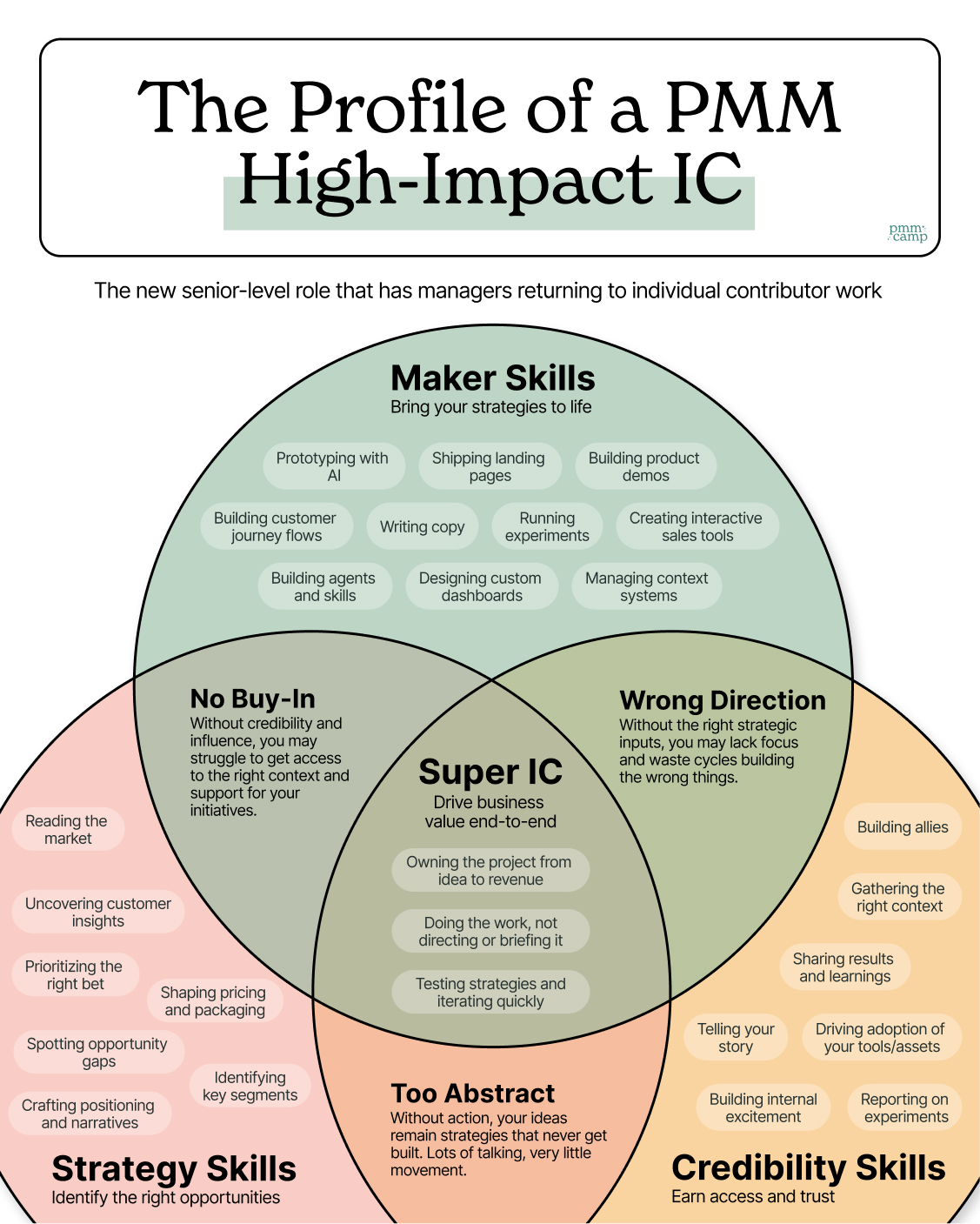
What does this mean for people managers?
Elena argues that the management level, especially middle management, is collapsing. Her point is that most of management exists to coordinate work. Managers review work, approve decisions, and move information up and down the business. That made sense when building was slow and expensive, because you needed to get things right before you committed to them.
But when you can build and test something in hours, Elena says it becomes cheaper to just try something rather than to debate it.
That's mostly true, but it creates some downstream implications too.
What happens when you have a company of Super ICs running experiments and shipping rapidly without a manager reviewing the strategy? I think it'll get messy real quick.
Sure, it might be cheaper to build now, but that doesn't mean it comes without a cost. We need to consider the end-customer experience. Customers can only absorb so much information! Think about how overwhelming it would be to be exposed to an influx of experiments, features, and campaigns (especially if some are conflicting).
There needs to be a through-line. AKA, a cohesive strategy and a story.
There's an internal cost too. Without someone managing a bigger strategy and roadmap, you could get Super ICs building the same thing or even running experiments that work against each other. The vectors will not be aligned.
Where Elena sees the manager becoming optional, I think the opposite. The more building gets democratized, the more that role matters.
We still need people managers. We also need experienced builders with high agency and judgement. I think what we're really seeing is the emergence of two distinct types of leaders.
The first leads through people. They align the team, manage the roadmap, and make sure everyone is pointed in the same direction. This is the manager, and we still need them. (Side note: this doesn't mean they can't also build things. Managers will be expected to be much more hands-on moving forward, even at VP and C-level roles).
The second leads through the craft. They can take a project and own it end to end, mostly on their own. This is the Super IC.
So, back to Maria's question at dinner. Which leadership role would you choose?
There's no right answer. There's only the right answer for YOU. And I suspect many PMM leaders will actually ebb in and out of both roles over the coming years.
Until now, it hasn't really felt like a choice. For years the only way up was through people management, so that's the path people took. Plenty of great builders ended up managing because it was the only way to get paid more. That's all changing. You don't have to manage people to have real impact or to be seen as a leader.
But I want to be careful here. There's a lot of talk right now about the Super IC being a flex. We spent years telling people management was the only goal worth striving for. Let's not turn around and glorify the other one instead. They both matter.
So, which path do you want to take? That's a question worth noodling on.
CAMPER ESSENTIALS
Give Elena's original blog post a read. I'll love to hear your take on both of our perspectives (there's some overlap, some differences).
Not sure which path is yours? The PMM Leadership Assessment shows you which of the 5 Modes you're strongest in so you can double down on your strengths and fill your gaps. It's free, and only 30 questions long.