#168: The AI Setup Most PMMs Skip
How to build your PMM context management system
If there's one thing I hear consistently from PMMs right now, it's that they feel intense pressure to adopt AI.
There's a real sense of urgency from leadership to automate their work, move faster, and do more. Which means product marketers are always on the search for the best prompts and newest tools.
But, somehow, the output continues to feel generic. Not quite good enough to actually do the job.
I've been in that same place, so earlier this year I decided to actually do something about it. I hired my pal Denny Hollick to be my personal AI coach.
Denny and I go back to our Unbounce and Kajabi days, and he spent the last year as a solo Head of PMM at a startup using AI to do the work of a full team. He's not an AI theorist. He's built things with it under real constraints and figured out what actually works for product marketers. Now, he helps teams build practical AI skills through hands-on workshops and assessments.
Denny taught me that before I jumped right into tools like Claude Code, I needed to go back to the beginning. I needed to lay the right foundation for my AI to actually understand my business and my customers. I needed to to build a context management system.
And that's exactly what we're going to explore in today's edition. How to build a system that turns generic AI output into publishable first drafts, and more.
Let's get into it.
Context Management for PMMs
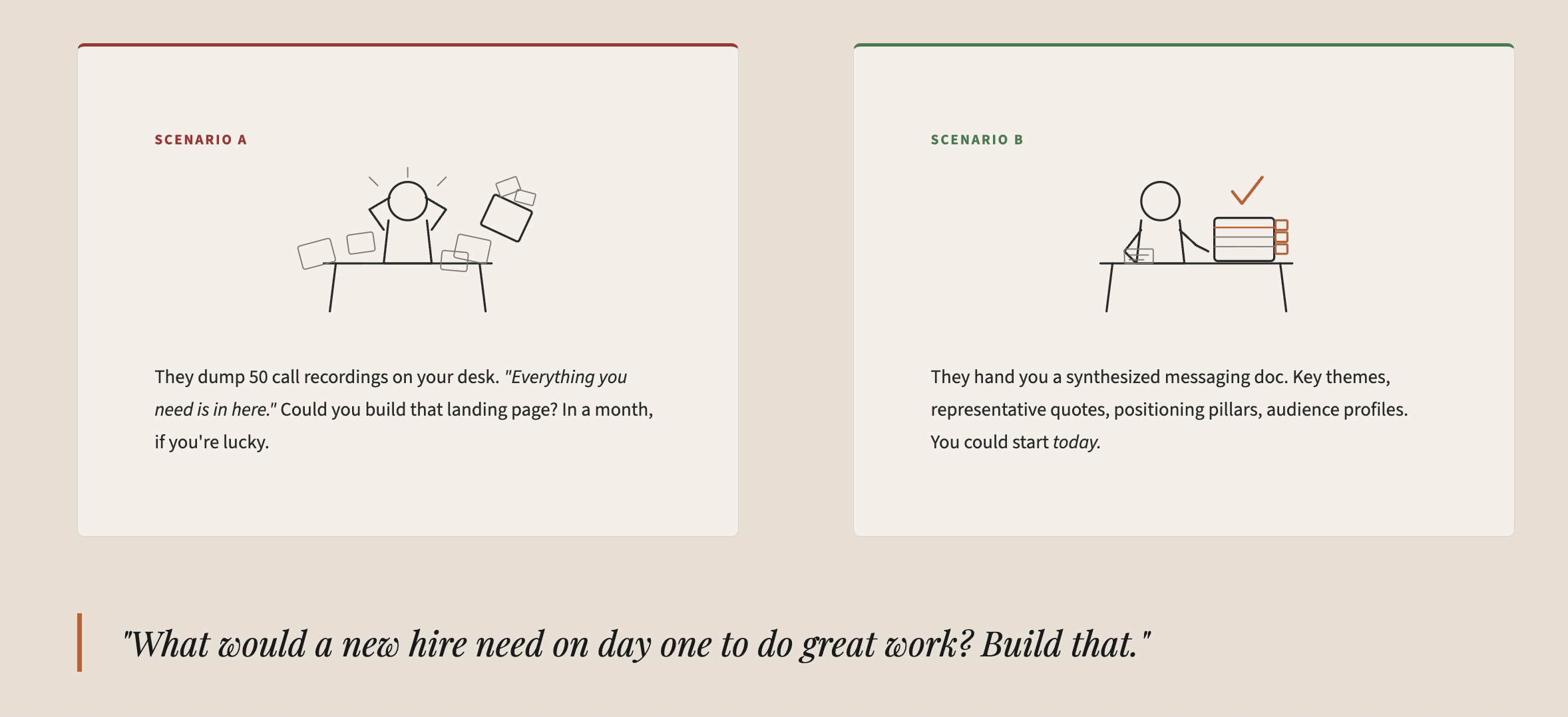
Imagine it's your first day at a new job. You sit down at your desk excited to get started, and your manager shares a Google Drive with you. "Everything you need is on there," they say. Fifty call recordings, a folder of old pitch decks, some Slack conversations, and a brand guide from 2024.
Could you write a new product landing page? Maybe in a month, if you're lucky.
Now imagine a different first day. Your manager hands you a strategy document that's structured and easy to navigate. It includes key customer themes (with quotes), audience profiles, messaging pillars, and competitive angles. I bet you could write a fairly compelling landing page by the end of the week.
That's exactly how your AI works. It can only do great work with what you give it. And most of us are handing it the Google Drive, not the strategy document.
Context Management 101
Here's what's actually happening under the hood when you use a tool like Claude or ChatGPT.
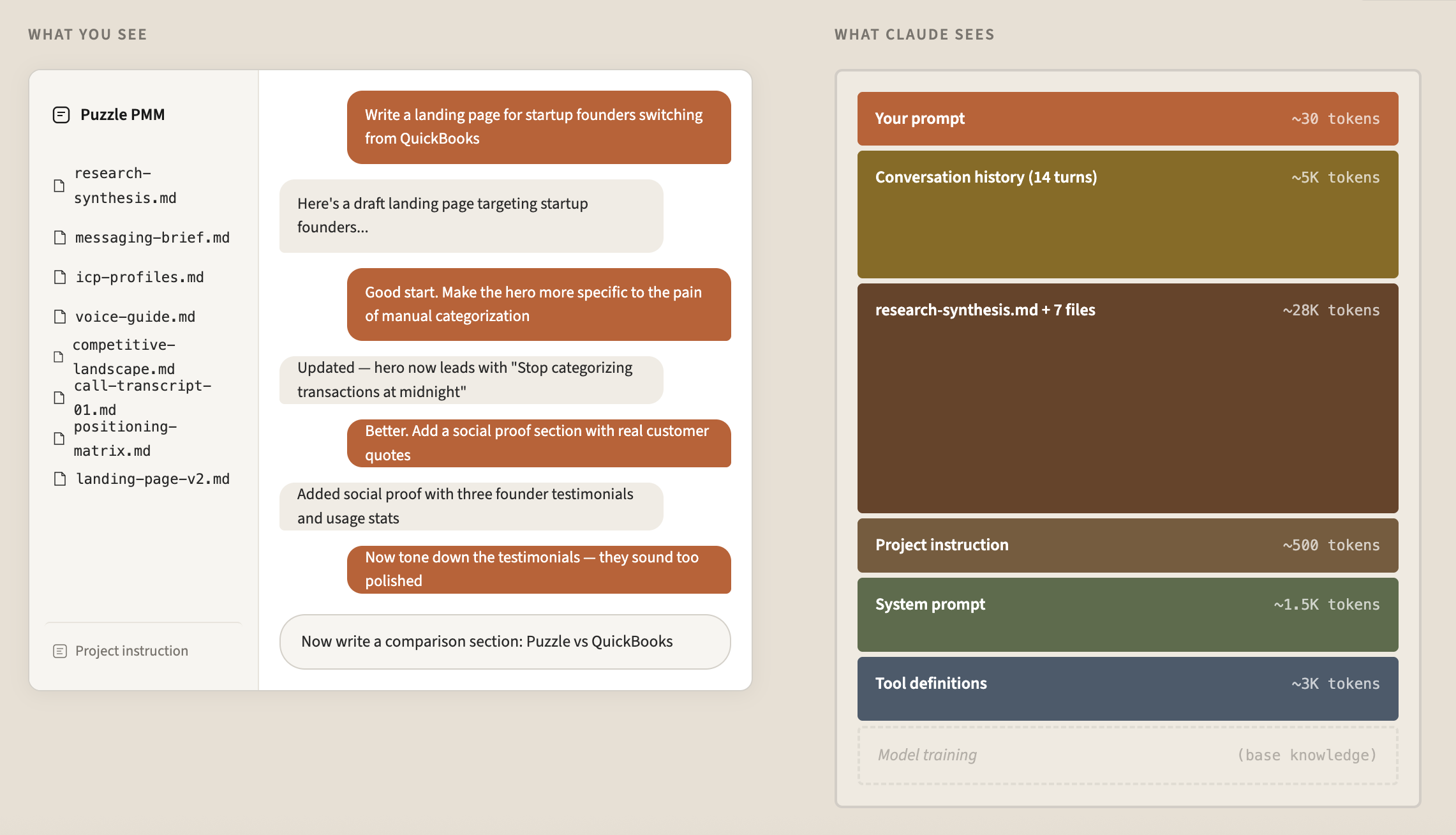
Every conversation runs inside something called a context window. You can think of it as the model's working memory. Everything in that window is the only reality the model knows: your instructions, the files you've attached, your conversation history, and whatever you just typed.
Every time you hit send, the model doesn't just read your latest message. It re-reads the entire window from scratch, as if the conversation is starting over.
So as your conversation grows longer, the model's grip on the earlier material weakens. Output that was on point early on gets vague and generic later. Denny calls this context drift.
Our instinct is to add more, but that usually makes things worse. More unstructured information doesn't help the model focus, it dilutes its attention across everything you've thrown at it.
So what does good context actually look like?
Good context is distilled. It's the synthesis of your raw material — the key themes from your customer calls, the voice of customer, your positioning pillars, who you're talking to, and what they care about.
When Denny and I set up my context system, we built it around six core documents: a customer research synthesis, a messaging and positioning brief, ICP profiles, a social proof library, competitive intelligence, and a voice and tone guide.
It's actually what we're building inside PMM Camp this month as part of our AI Challenge (I brought Denny in to lead that too!).
3 Rules to Follow
Budget your context.
The context window isn't a filing cabinet, it's a budget. Every piece of information you add dilutes the model's attention on everything else. So you have to be ruthless about what earns a place in your project. And, outdated context isn't harmless. The model treats all of it as current truth, so stale context actively works against you.
Distill up, reference down.
Don't feed your AI raw data. Feed it a synthesis of that data. Your job is to reduce, concentrate, and get to the essence. Find the themes, patterns, and actual customer language that matters most. Keep that curated summary in your project and point to the raw sources only when needed.
Test, review, iterate.
You can't build your context in isolation and hope it works. Run a real prompt, see what's wrong with the output, fix the context that caused it, and repeat. The trap here is letting AI-generated content feed back into your context files without reviewing it first. Errors compound, and the context drift is subtle enough that you might not notice until the output is completely wrong.
Most of us (myself included!) have been so focused on finding the right prompt or the next best tool that we've skipped right over this. And that's why our AI output stays a bit underwhelming. Since working with Denny, the quality of what I'm able to produce with Claude has significantly increased. Not to mention, I'm starting to actually understand how these systems work, which is perhaps even more important to long-term success.
So before you chase the next AI prompt or skill pack, ask yourself: what have I actually given my AI to work with? Does it know my customers? Does it know my positioning? Does it sound like me? If the answer is no, then go back to the beginning and start with context management.
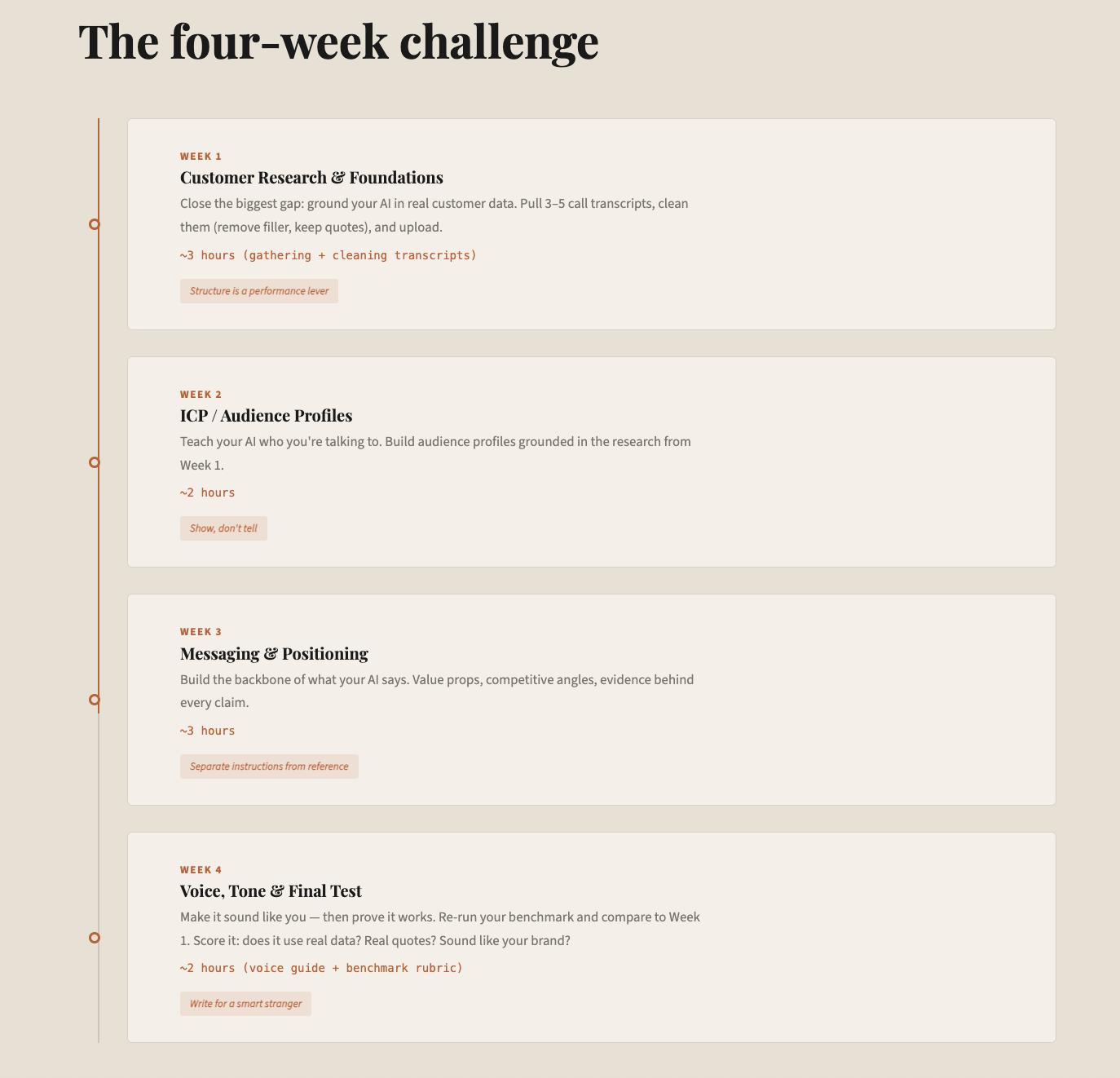
This month inside PMM Camp, we're building our context management systems together! We just wrapped up Week 1, which was focused on creating our customer research synthesis from real transcripts, reviews, and customer data. If you're a Camper, jump in and wrap up your Week 1 homework before we move onto ICP and audience profiles next week.
Not a Camper yet? I'm dropping the four-week calendar below so you can follow along on your own.
CAMPER ESSENTIALS
Join the PMM Camp Community! Learn how the best PMM leaders are adopting and experimenting with AI. New spots open April 1 to 5, and are only offered to accepted applicants. Apply now to get on the waitlist.
Listen to my fave new podcast, Product Marketing for You. The super smart Adam O'Brien just launched season 1 of the pod, and each episode focuses one specific part of product launch (from buyer research to messaging drift). They're less than 20-minutes long, and completely bingeable. All 9 episodes are available now on Spotify.
How do you AI? Take Denny's free quiz to find your AI archetype and get personalized recommendations on how to improve. Start the quiz here.
Explore the Big AI Product Marketing Report. Rory Woodbridge put together a report that shares how PMMs from 27+ countries are using AI in their work. Read it here.