#161: The Operator
Why the strategic vs tactical PMM debate is a false choice
On LinkedIn and at product marketing conferences, I often hear people position themselves in one of two camps: "I'm a strategic product marketer" or "I'm a PMM who actually gets things done."
It's presented as if you have to choose. As if being strategic means you're above the work or being good at execution means you're a better PMM.
This is an false choice.
If you're only doing strategy, sitting in your ivory tower designing the future without grounding it in reality, you're going to be out of touch. You won't know if your strategy actually works. You'll have no feedback loop to iterate and improve. Strategy without execution is just theory.
But it's equally true that if you're stuck in pure execution mode, you could be executing brilliantly on the wrong things. You could ship everything on your list and still not move the business forward. Execution without strategy is just busywork.
The Operator mode isn't about choosing one over the other. It's about ownership. The best product marketing leaders take a strategy and make it real. They translate a vision into focused work, define what success looks like, and make it easy for everyone to see how PMM is moving the business forward.
And that's the topic of this week's newsletter.
Over the coming weeks, we're diving into each mode from my new leadership framework, the 5 Modes of PMM Leaders. Last week was the Strategist. This week, it's the Operator.
The Operator
Operator mode is about turning strategy into business impact.
It's your ability to translate company priorities into a small set of clear PMM objectives, define the right success metrics, and create a steady cadence of updates that make progress and outcomes easy for others to understand.
Strong Operators don't just execute, they make it obvious how PMM moves the business forward.
What Good Looks Like
When I think about leadership mastery in any of the five modes, I look at it across three levels: Emerging, Influential, and Indispensable. This helps make the mode more tangible by showing how it actually shows up in practice and how it evolves over time.
At the emerging level:
You've built a plan with objectives, initiatives, and metrics, but it's trying to do too much at once. It's not clear which initiatives matter most or how the work connects back to company priorities.
When company goals are fuzzy or unclear, your team struggles to prioritize.
You share updates inconsistently or only when someone asks. Stakeholders don't really understand what PMM is working on or why it matters.
Your updates focus on what you shipped, not what changed as a result.
At the influential level:
You're building a stronger plan that connects company goals to clear PMM objectives, initiatives, and metrics. It shows good judgment, even if some pieces still need work.
PMM's direction is mostly clear. There might be debate about scope or metrics, but you can explain your thinking.
You've started building communication rituals, but the stack isn't complete. Information gets shared, but it doesn't always land because it's not right-sized or well-timed for each audience.
Updates don't consistently help people make decisions or take action.
At the indispensable level:
You build a plan that translates company goals into work PMM can actually own. When inputs are incomplete or ambiguous, you create clarity by connecting the dots and shaping direction.
It's obvious to everyone what PMM is committing to, why it matters, and how you'll measure success.
You run a deliberate communication stack that makes PMM's impact visible at every level of the organization.
The right information reaches the right audience at the right time, creating clarity and momentum so decisions move faster and PMM's value compounds.
If you're curious where you currently sit in Operator mode, complete the PMM Leadership Assessment (it's free and only takes 5 minutes). It maps how you're operating today across this mode and the others, so you can see both where you're strong and where there's room to grow.
The Operator Habits
Once you have your results, the next question becomes: How do you actually strengthen this mode?
Leadership range isn't something you unlock all at once. It's built gradually, through small, intentional shifts in how you think, decide, and show up in your role. Each mode in the framework is supported by a set of habits that make it usable in practice.
For Operator mode, those habits are about grounding PMM's work in what matters to the business and making that impact consistently visible.
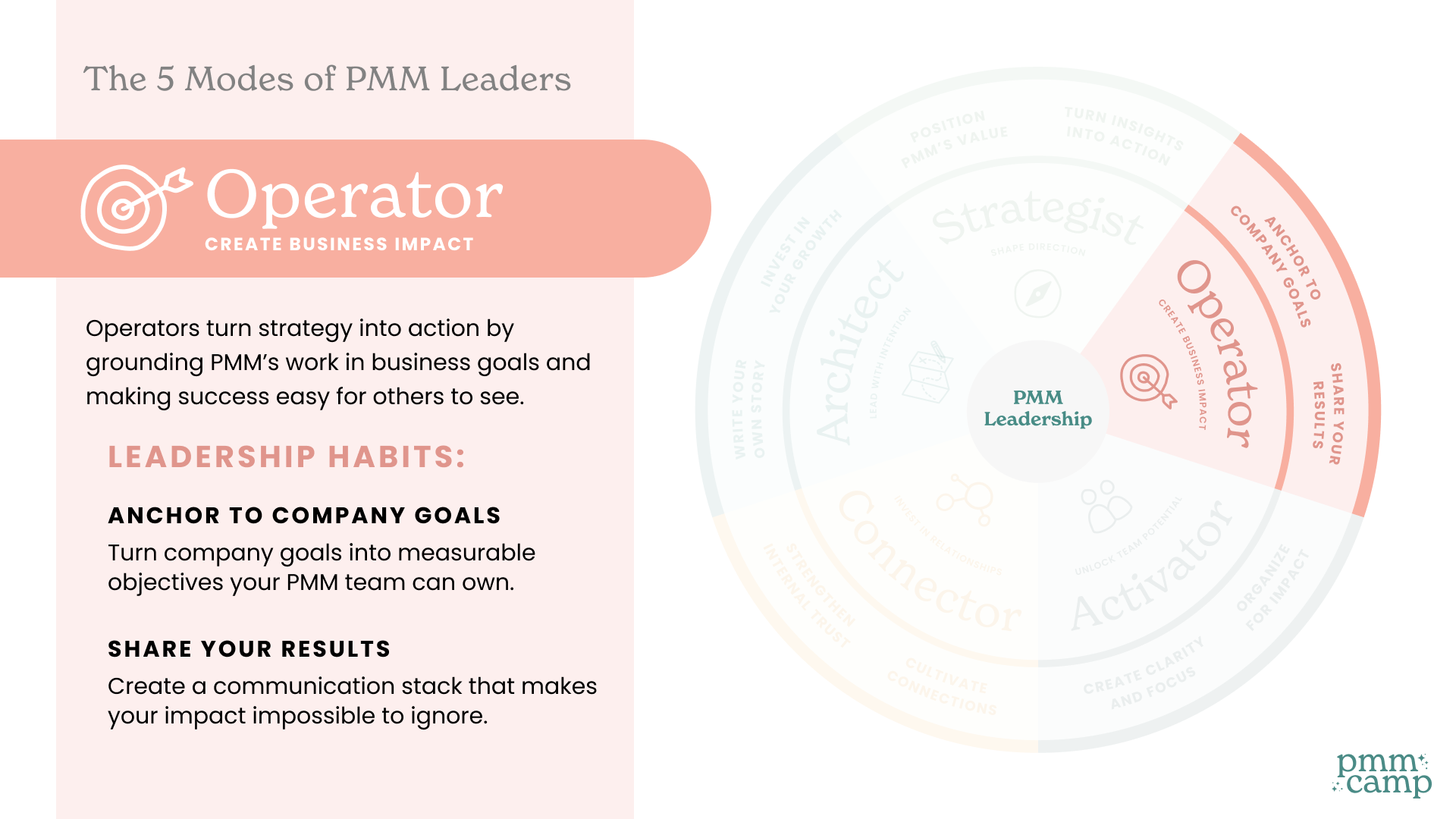
Anchor to Company Goals
This habit is about turning company goals into measurable objectives your PMM team can own. This grounds PMM's work in what the business is trying to achieve, making it easier to focus on the right things and harder for high-impact work to get sidelined or overlooked.
The process looks like this:
Gather company goals and leadership priorities
Connect company goals and priorities to PMM focus areas
Define actionable objectives that bring each focus area to life
Prioritize initiatives that will deliver the greatest impact
Map success metrics that ladder directly to business results
Create a strategic roadmap that keeps everyone aligned and accountable
This is all about building a plan that the business understands and trusts.
Share Your Results
This habit is focuses on making sure people actually know what you're working on and why it matters. Too many PMM leaders do great work and then wonder why leadership doesn't see the value.
Strong Operators build a communication rhythm (I call it a communication stack). They capture small wins daily, share progress weekly, highlight outcomes monthly, report results quarterly, and reflect annually. It doesn't have to be complicated, it just has to be consistent. When you build this habit, PMM's work becomes visible and your impact starts to compound.
When to Activate Operator Mode
Operator mode usually needs to be activated when you've lost the connection between strategy and execution. Some signals to look for:
You're spending a lot of time designing strategy but not actually testing whether it will land. You're talking about the work instead of doing it.
Your head is in the sand. You're executing on tasks but can't clearly explain how they connect to company goals or a bigger why.
People keep asking what PMM is working on or why you're focusing on certain things. They can't see the through line to what the business is trying to achieve.
Stakeholders are constantly chasing you for updates, clarifications, or metrics instead of knowing where to find them.
You have metrics but struggle to explain whether they're actually the right ones.
This is when you need to build the connective tissue between what you're doing and why it matters. But, like any mode, Operator mode can work against you when it's overused. A few things to watch for:
You take pride in being the PMM who gets things done, but you've stopped stepping back to question whether you're executing on the right strategy.
You're so focused on hitting your metrics but can't explain how they connect to company goals.
Reporting becomes a performance. You're trying to make yourself look good instead of surfacing the right information to help the company make better decisions.
When this happens, it's often a sign that Operator mode needs to be pulled back and another mode needs to be activated.
CAMPER ESSENTIALS
Watch this great breakdown of Granola's rebrand. My friend Alicia recorded an 8-minute video sharing exactly why Granola's new messaging works so well. It's a masterclass in thoughtful positioning that clearly signals who the product is for. Get the post and video here.
Take the PMM Leadership Assessment. Discover how you’re currently leading across the five modes and where building range could have the biggest impact.